How to Evaluate a Municipal Social Media Vendor
Five models local governments buy, and what each one counts as winning
Municipal social media vendors fall into five models: compliance tools, peer validation, agency retainers, page management, and capability building. Each solves a different problem and should be judged against a different outcome. Local governments routinely assume they are all buying the same result, and they are not. Compliance tools are the only model that can be complete on their own terms because records compliance is a discrete problem with a discrete solution. The other four are frequently sold as full solutions. A community evaluating a vendor should ask what changes for residents, what staff can do afterward, whether trust moved, and whether organizational risk went down. Content volume, reach, awards, and deliverables measure activity, not outcome.
Five Models of Municipal Social Media Support
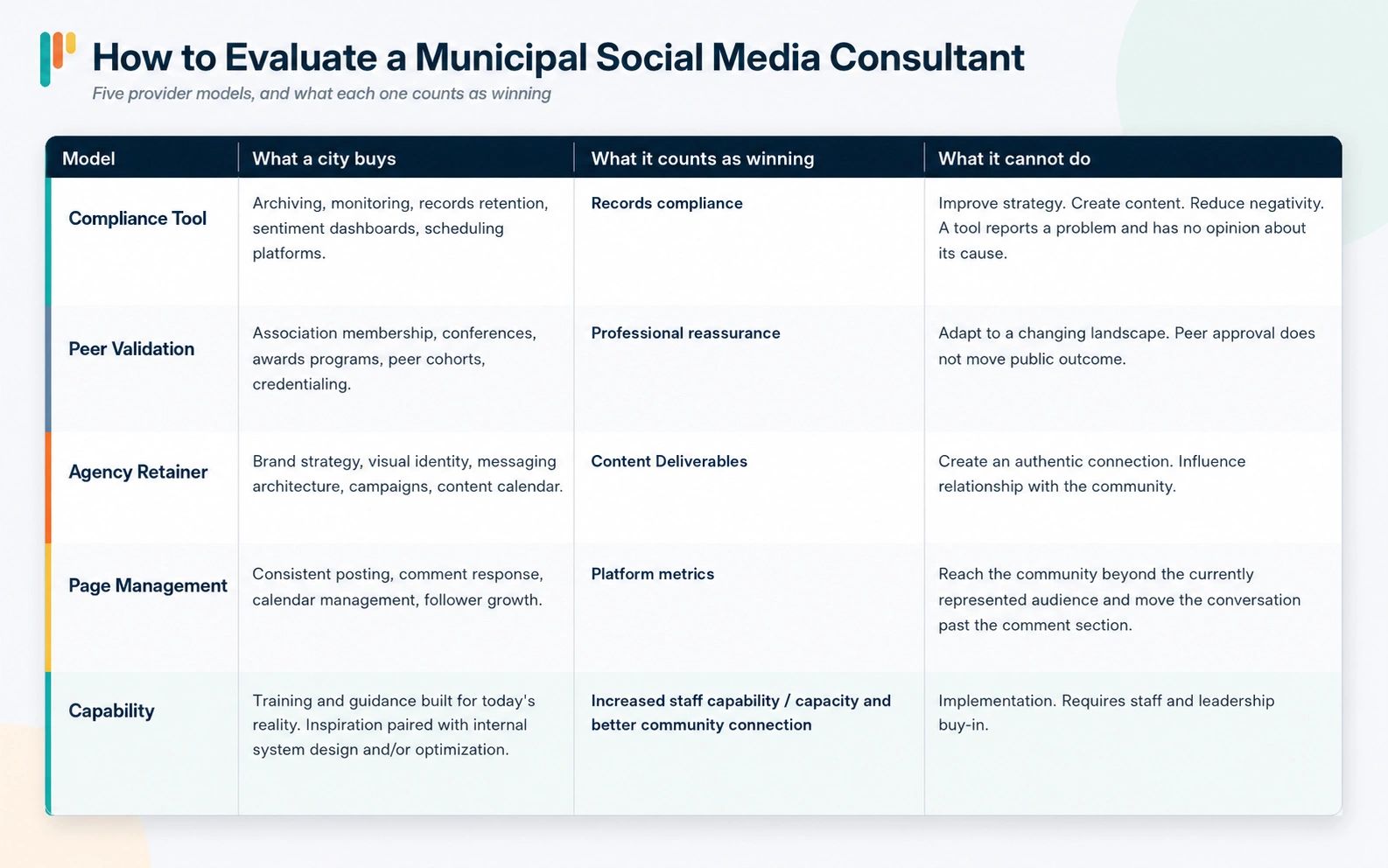
What does a municipal social media consultant actually do?
It depends entirely on which of the five models a vendor operates in. The category names are mine. The distinctions are not controversial, and any local government that has hired in this space will recognize all five.
The Compliance Tool Model
- What it is: Software. Archiving, monitoring, records retention, sentiment dashboards, scheduling platforms. A city procures a tool, connects its accounts, and populates a dashboard.
- The honest case for it: Public records obligations are real, and they are not optional. A city that cannot produce its social media records on request has genuine legal exposure. Retention requirements apply to comments and direct messages as much as to posts, and no manual process survives contact with volume. These tools close that gap and they close it well. This is the one category on the list that is complete on its own terms, meaning it fully solves the problem it claims to solve. Every city should own one.
- What it counts as winning: Records compliance.
- Where it falls short: A tool measures. It does not decide. The most common failure here is not a missing dashboard, it is a city staring at one with no framework for what to do next. Sentiment drops and the response is to post more. Reach declines and the response is to boost. The software reported the problem accurately and had no opinion about the cause.
Buying a compliance tool and calling it a strategy is buying a thermometer and calling it medicine.
The Peer Validation Model
- What it is: The professional association layer. These are consultants who are well known at conferences like 3CMA and Government Social Media, have won their awards, and heavily tout their credentialing.
- The honest case for it: Municipal communications is a lonely job. A large share of these roles are one person handling every channel for an entire city, frequently reporting to a manager who has never done the work and cannot evaluate it. Peer networks give those practitioners training, somewhere to ask a question at four in the afternoon when something is going wrong, and evidence to a skeptical city manager that this is a profession with standards rather than an intern's assignment. Several of the best communicators I have worked with came up through these organizations.
- What it counts as winning: Professional reassurance.
- Where it falls short: Peer approval and public outcome are different measurements, and cities regularly mistake the first for the second. An award-winning campaign impressed a jury of practitioners. It did not necessarily move a resident, defuse a comment section, or pass a bond. There is a second problem specific to this model. The practices being validated were formed by the people validating them, in an environment that has since changed. This cohort is very good at reinforcing a shared standard and quite poor at noticing when the landscape fundamentally shifts.
The Agency Retainer Model
- What it is: A marketing or public affairs firm on monthly retainer. Brand strategy, visual identity, messaging architecture, campaign and/or messaging development, content calendar, quarterly reporting.
- The honest case for it: These firms do very beautiful and polished work. They always have the best brochures and are genuinely good at selling themselves. A town with six departments using four different logos, a website that contradicts its own printed materials, and no discipline about how it describes itself has a real problem. A competent agency fixes it. The work is professional, it arrives on time, and the organization looks better afterward.
- What it counts as winning: Content deliverables.
- Where it falls short: Local governments buy brand work and expect behavior change. Those are different purchases. A style guide does not tell a public works director what to say when four hundred people are angry about a boil notice. A messaging framework does not survive contact with a live comment section. Assets are not relationships, and no volume of well-produced content creates an authentic connection with a community that does not already trust the institution producing it. The economic impact also matters. A recurring retainer can produce a large volume of assets without necessarily changing the underlying public outcome. The firm will do exactly what it was hired to do. The scope was wrong, not the execution.
The Page Management Model
- What it is: The consultant's focus is about how to "run the pages". Consistent posting, comment response, calendar management, follower growth. Sometimes offered as best practices for the in-house team, sometimes offered on a contract, usually written into the RFP as "social media management."
- The honest case for it: These practitioners built this discipline. Ten years ago, a county with an actively managed page and a real posting cadence was ahead of the field, and the people doing that work were right. Consistency is a genuine skill, and a local government that cannot maintain basic cadence has a problem worth solving before it solves anything else.
- What it counts as winning: Platform metrics (followers, likes, comments).
- Where it falls short: The distribution model those metrics describe no longer exists. Social media platforms increasingly distribute content based on predicted viewer interest and retention rather than primarily through follower relationships.Content now competes for attention against everything else in a feed and wins or loses on whether it holds a viewer, not on whether an account has an audience. This produces a specific and very common outcome: a city with forty thousand followers whose posts reach less and less people. The page is being managed well. Their playbook teaches a process that has increasingly lost momentum. It also maintains emphasis on the "Same Ten People" problem. Under this model, the residents engaging are frequently the same small cohort of highly engaged critics. What's not being measured are the residents a local government needs to reach: families, working professionals, and small business owners. Most of them will never follow a municipal Facebook page or comment in a community group.
The Capability Model
- What it is: A capability-building approach that teaches local governments how to communicate in the way modern social platforms currently function. Leverages authentic staff voices, useful video, clear narrative, and content designed to reach beyond the people already following the city. It pairs that training with the internal structure needed to sustain it: who creates, how content moves, what gets cleared, how leadership participates, and how the organization learns from what works.
- The honest case for it: Elected officials do not judge a communications operation on follower growth, engagement rate, or whether the PIO was honored by a professional association. They judge it on whether residents feel their local government is present, responsive, and worth trusting. That is a question about the organization, not about the content, and it can only be answered by building organizational strength around modern communications.
- What it counts as winning: Increased staff capability, capacity, and better community connection.
- Where it falls short: This model requires staff and leadership buy-in, and that is a real cost the city bears rather than the vendor. Department heads must participate. Elected officials should be supportive. A communications director has to have their manager's full trust.
Capability is the CiviSocial model.
How should a city choose a municipal social media consultant?
Start with the outcome, not the vendor. If the problem is records retention, buy compliance. If the need is peer development, use professional networks. If the problem is brand consistency, an agency may be appropriate. If the goal is consistent channel operation, page management addresses that need. If the desired outcome is stronger internal capability, broader community connection, reduced organizational risk, and a communications system the city can operate itself, evaluate a capability-building model.
This website uses cookies.
We use cookies to analyze website traffic and optimize your website experience. By accepting our use of cookies, your data will be aggregated with all other user data.